


A leading environmental solution provider
Get in touch with us
For years, corporate sustainability officers handling large thermal footprints have shared a common frustration. While addressing Scope 2 emissions has a clear, global playbook; buy Renewable Energy Certificates (RECs) or sign a Power Purchase Agreement (PPA) - tackling Scope 1 emissions has felt like running a marathon in combat boots.
Historically, if a corporate facility couldn’t pipe Renewable Natural Gas (RNG) directly to its gates or prove an ironclad, physical contractual connection through a local pipeline, market-based mechanisms like unbundled Renewable Thermal Certificates (RTCs) or Biomethane Certificates were flatly rejected by the Science Based Targets initiative (SBTi). The old mandate was unyielding: direct physical sourcing or it doesn’t count.
That rigid paradigm just shifted. With the official release of the SBTi Corporate Net-Zero Standard V2.0, the rulebook for corporate climate action has evolved from pure idealistic ambition to pragmatic, real-world implementation.
For global and US-headquartered corporates, the implications for unbundled RNG certificates are profound. Here is the AFS breakdown of how SBTi V2.0 changes the game for your Scope 1 strategy.
The Shift: The Target Implementation Hierarchy
The most significant structural change in SBTi V2.0 is the introduction of a formalized Target Implementation Hierarchy. SBTi has acknowledged a hard reality: companies operate within shared, complex infrastructure systems where direct physical traceability is frequently impossible or economically prohibitive.
Instead of an outright ban on market-based instruments for Scope 1, V2.0 establishes a tiered approach to how companies can implement their targets:
• Activity-Level Actions: Direct on-site decarbonization, such as energy efficiency overhauls and asset electrification.
• Activity Pool-Level Actions: Interventions in shared systems or 'sourcing sheds' (e.g., the regional gas grid or shared logistics networks).
• Sector-Level Actions & Market Instruments: Sourcing high-integrity commodity and energy certificates to stimulate market demand and scale transition-critical technologies.
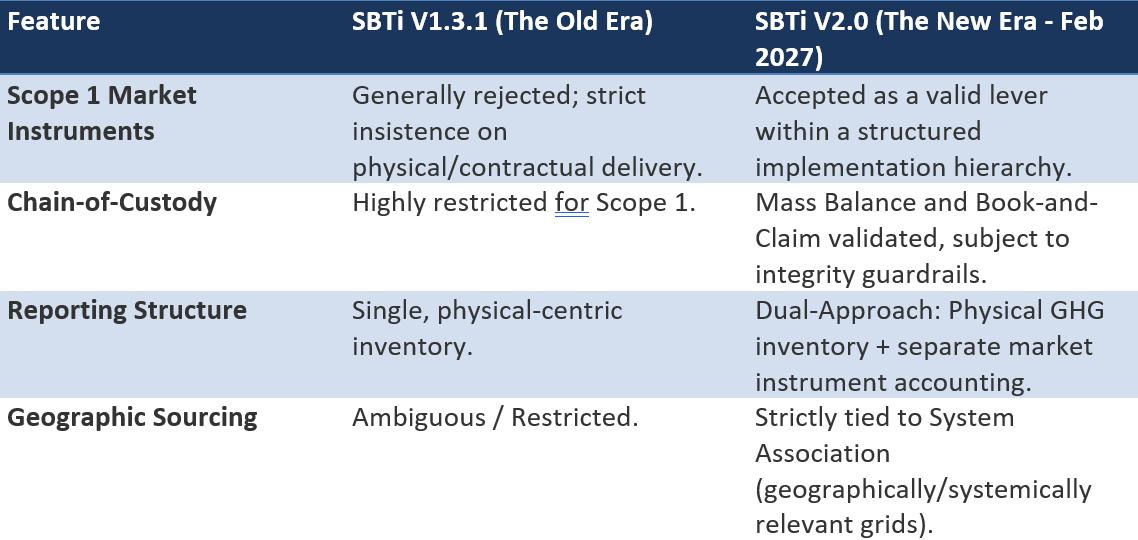
By explicitly embedding market instruments into this hierarchy, SBTi V2.0 officially opens the door to chain-of-custody models like mass balance and book-and-claim for commodities, provided they meet strict credibility guardrails.
The Core Implications for Unbundled RNG Certificates
If your organization has been sitting on the sidelines of the RTC market due to regulatory uncertainty, V2.0 changes your risk calculus. The usability of unbundled RNG certificates now hinges on three core pillars:
1. Dual-Inventory Reporting (The "Separate Ledger" Approach)
SBTi V2.0 bridges the gap between strict physical accounting and market flexibility by requiring companies to report a physical GHG inventory while separately accounting for and reporting the impacts of market instruments. What this means in practice: You cannot simply subtract unbundled RTCs to artificially erase your physical Scope 1 smokestack emissions. Instead, you report your physical footprint and use high-integrity certificates to demonstrate clear, validated progress toward your SBTi-approved transition and implementation targets.
2. Strict "System Association" Guardrails
To prevent a company in New York from buying cheap, poorly tracked biomethane attributes from a completely disconnected global market with zero systemic impact, SBTi V2.0 introduces Minimum Integrity Criteria (C25 & C27). Market instruments must possess "system association" - meaning the certificates must be generated within a geographically or systemically relevant system into which your company feeds or from which it sources (e.g., the North American natural gas grid).
3. The Upcoming Interoperability and Recognition Framework
SBTi is not acting entirely alone; they are coordinating closely with the ongoing Greenhouse Gas (GHG) Protocol revisions. To provide immediate clarity, SBTi is launching an Interoperability and Recognition Framework in Q4 2026. This framework will explicitly vet and list certified registries and environmental attribute systems (like M-RETS or green gas registries) that meet their high-integrity criteria.
Side-by-Side:Checking the Corporate Playbook
TheCorporate Timeline: Don't Wait for the Cliff Edge
While the Corporate Net-Zero Standard V2.0 was finalized in June 2026, it officially becomes available for corporate target-setting on February 1, 2027.
This transition window is highly strategic. In Q4 2026, SBTi will release its explicit Scope 1 Implementation Hierarchy Interpretation Guidance. Corporates that wait until 2027 to formulate their strategy risk being caught in a supply squeeze for high-integrity, system-associated RNG certificates
TheAFS Perspective: How to Position Your Procurement
The message from SBTi V2.0 is loud and clear: Pragmatism is winning over dogma, but integrity remains non-negotiable. Unbundled RNG certificates are transitioning from a compliance grey area into a verified, board-defensible tool for managing transition risk and driving capital into the circular economy.
To ensure your Scope 1 strategy aligns with V2.0, US and global corporates should take the following steps today:
• Audit Your Sourcing Boundaries: Evaluate your thermal energy footprint against the regional pipeline infrastructure to map out your "system association" boundaries.
• Prioritize Registry-Backed Certificates: Avoid opaque, over-the-counter attributes. Focus entirely on RTCs and biomethane certificates tracked on robust, third-party audited registries.
• Initiate Market Discovery and Scenario Modeling: Begin mapping out current market liquidity and running cost simulations against different pricing scenarios. Rather than locking in volumes today, establishing early relationships with suppliers and understanding where high-integrity supply sits ensures your team is positioned to execute swiftly and budget accurately the moment the final Q4 2026 guidelines drop.

